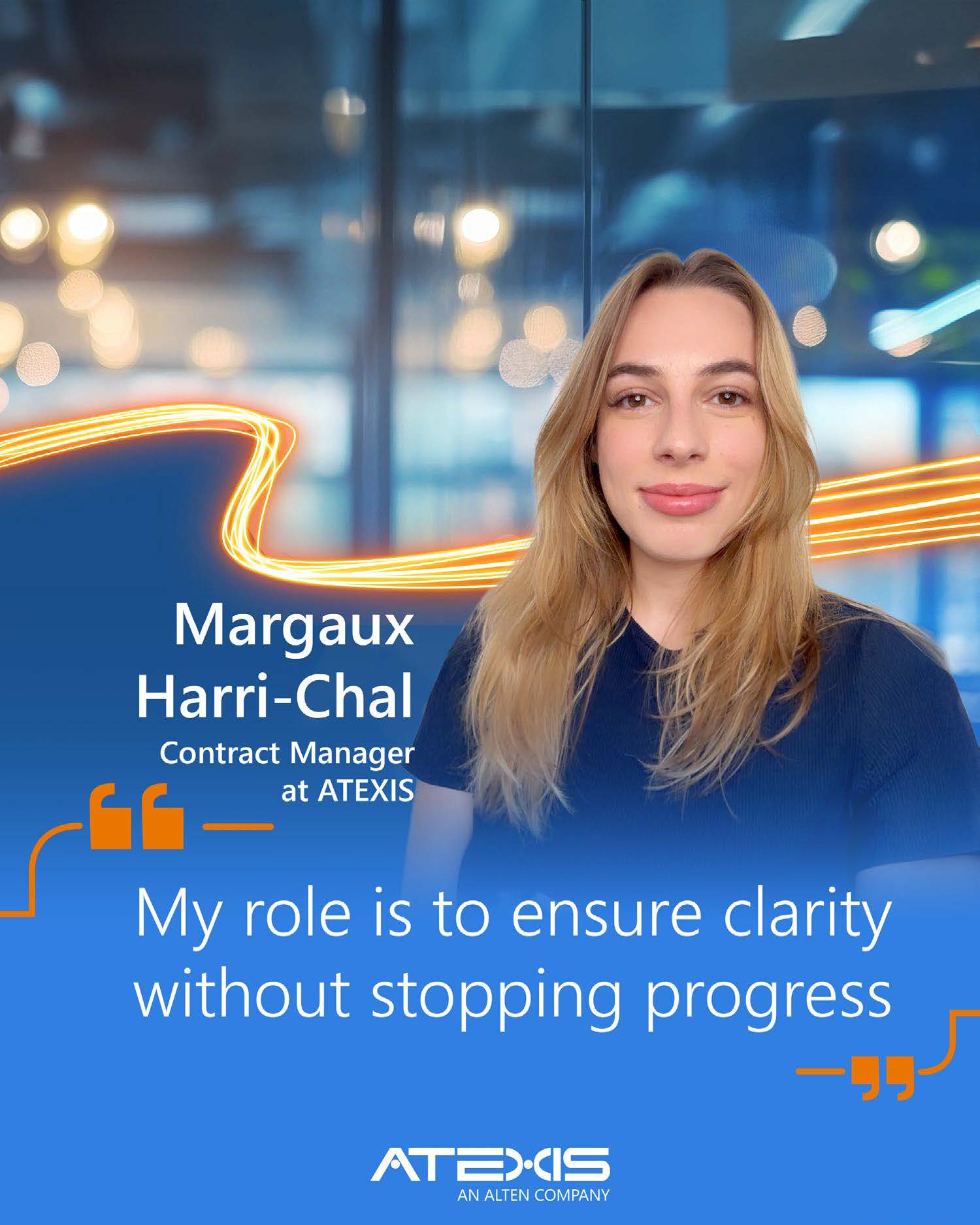
At ATEXIS, we are fortunate to have talent who turn challenges into opportunities. Today, meet Margaux HARRI-CHAL, our Contract Manager, whose mission is as exciting as it is essential: to make contracts an asset rather than a headache for our teams.
What is the essential skill to be a Contract Manager?
The spirit of synthesis.
Not in the sense of « making it short », but in the sense of making it clear.
Transform dense contracts, sometimes contradictory requirements and somewhat vague risks into something understandable — and above all actionable — by the teams.
Reading between the lines, sorting out the essentials of secondary school, explaining without drowning or oversimplifying it.
That’s what makes it possible to go from a contract that you sign… to a contract that we really use.
Without a spirit of synthesis, the contract remains a document.
With it, it becomes a management tool.
What motivates you the most in your job?
To be useful and to have a real impact.
I like it when the contract stops being perceived as a constraint and becomes a lever. When people come to see me not out of obligation, but because my gaze can save time, avoid a risk and bring serenity to my interlocutor.
What motivates me is to see the concrete effect of my work: a more secure decision, a team that moves forward more serenely, a project that regains clarity.
It’s this mix of thinking, pragmatism and real impact that makes me want to continue.
Can you tell us about a significant challenge in 2025?
One of my most striking challenges in 2025 was to intervene on a project that had already been launched, with a « badly put together » contract… and a loss of confidence of our teams in our co-contractor.
Unfortunately, the contract ticked a lot of well-known boxes: a flat rate, unavailable or poor quality input data, no provision to manage developments, a vague scope and a non-existent sharing of responsibilities with our partner.
On a project that had been underway for several years, this accumulation had ended up wearing out the teams.
Our relationship with our co-contractor was degraded, trust was damaged, and each subject became a point of friction. The financial losses were significant and, on a daily basis, the same questions came up — with an increasingly palpable exasperation:
« Is it in the contract? »
« Who is responsible for what? »
« And above all… How can we get out of this situation? »
My role was to provide clarity without slowing down the momentum: to take over the contract, to objectify the grey areas, to clarify what was part of our commitments, those of the partner, and to identify concrete options to get out of the impasse.
The issue was not only contractual. He was above all human. When a team is « at the end », emotion naturally takes over. It was necessary to listen, to acknowledge this fatigue, and then to refocus the exchanges on factual and objective elements in order to rebuild a defensible and acceptable position.
It is in this type of context, imperfect but very real, that contract management takes on its full meaning.